No scare tactics. No “act now or lose your house.”Just the form number, the phone script and the date — and a plain answer to whether it applies to you.
Find the chapter that's about you.
You don't read it front to back. Pick your situation, turn to that chapter, and do the one thing at the end of it.
Chapter 12 · The $29,093 Line
Your husband or wife served in wartime
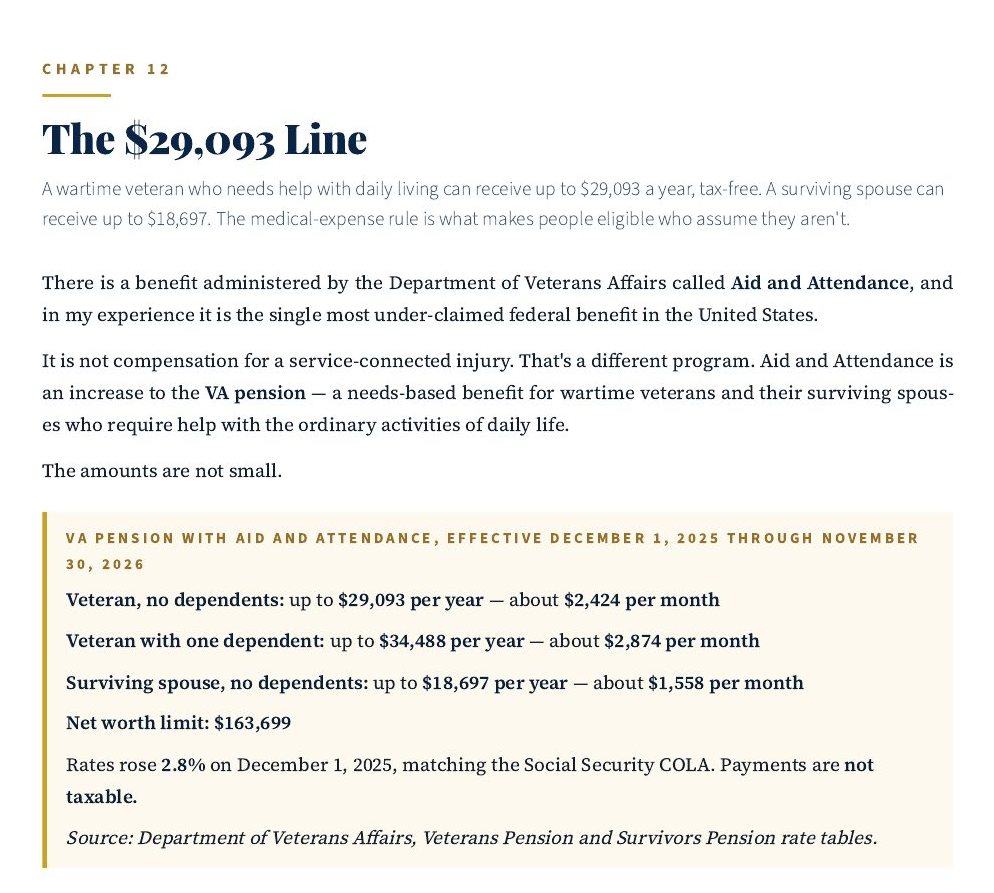
A wartime veteran who needs help with daily living can receive up to $29,093 a year, tax-free; a surviving spouse up to $18,697. Medical costs are subtracted before your income is tested.
Chapters 5–8 · Your property tax bill
You own your home and you're 65 or older
Five exemptions your county won't mention, why the assessment is a guess, and how to appeal with the evidence review boards actually accept. State-by-state table in the back.
Chapter 9 · The surcharge triggered by one good year
Medicare raised your premium
The surcharge is priced off a tax return from two years ago. If you retired or lost a spouse since, form SSA-44 asks them to recalculate.
Chapter 2 · The eighteen months that decide everything
You're deciding when to claim Social Security
The window that sets your check for the rest of your life — and the mistakes that can't be undone once you file.
Chapters 4 & 13
You recently lost a spouse
The switching strategy for survivors, and the three agencies that each need the same death certificate — in the order to call them.
Appendix F · The Drawer File
You're helping a parent
What to find, where it lives, and what to ask before you ever need it. One afternoon, one folder.
Every chapter ends with one thing to do — usually a single phone call or a single form.
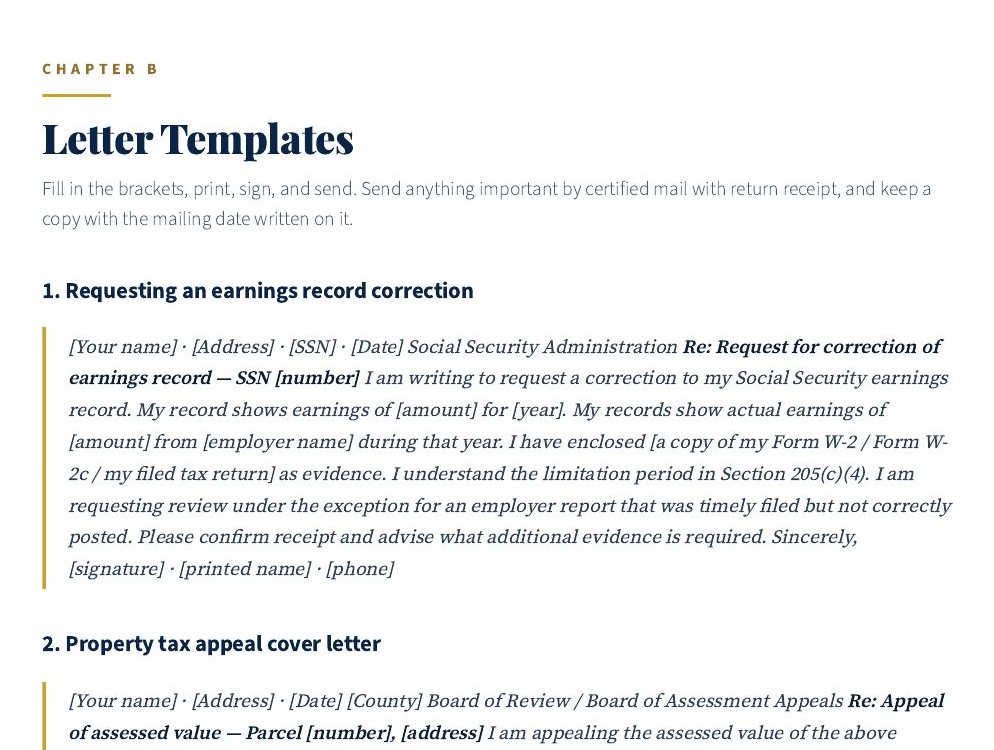
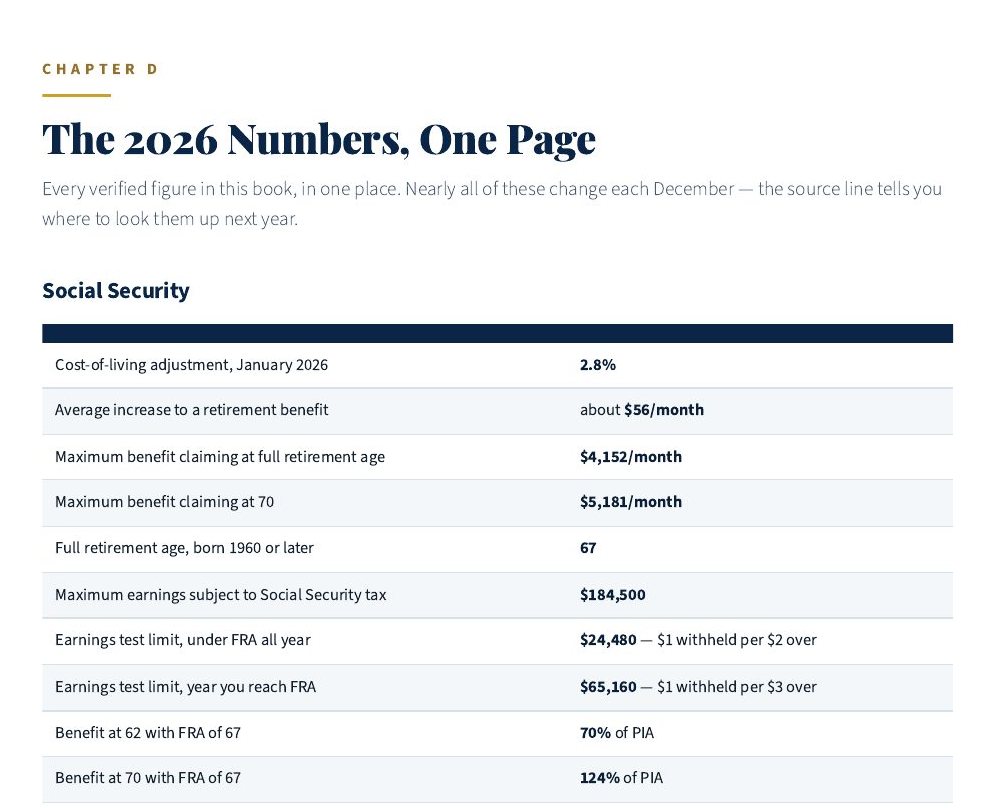
This is what the pages actually look like.
“It's not we don't know about it. It's that we get denied.”
@sweetchinmusiq1623 · 22 likes, under our video on the VA pension
Most claims don't fail on eligibility. They fail on paperwork.
- “Too many assets.”For the VA pension, your home and your car generally don't count toward the net-worth limit of $163,699. Chapter 12 shows what does.
- “Income too high.”Unreimbursed medical costs — assisted living, in-home care, insurance premiums — are subtracted before your income is tested. A widow on $28,800 a year who pays for assisted living can have a countable income of zero.
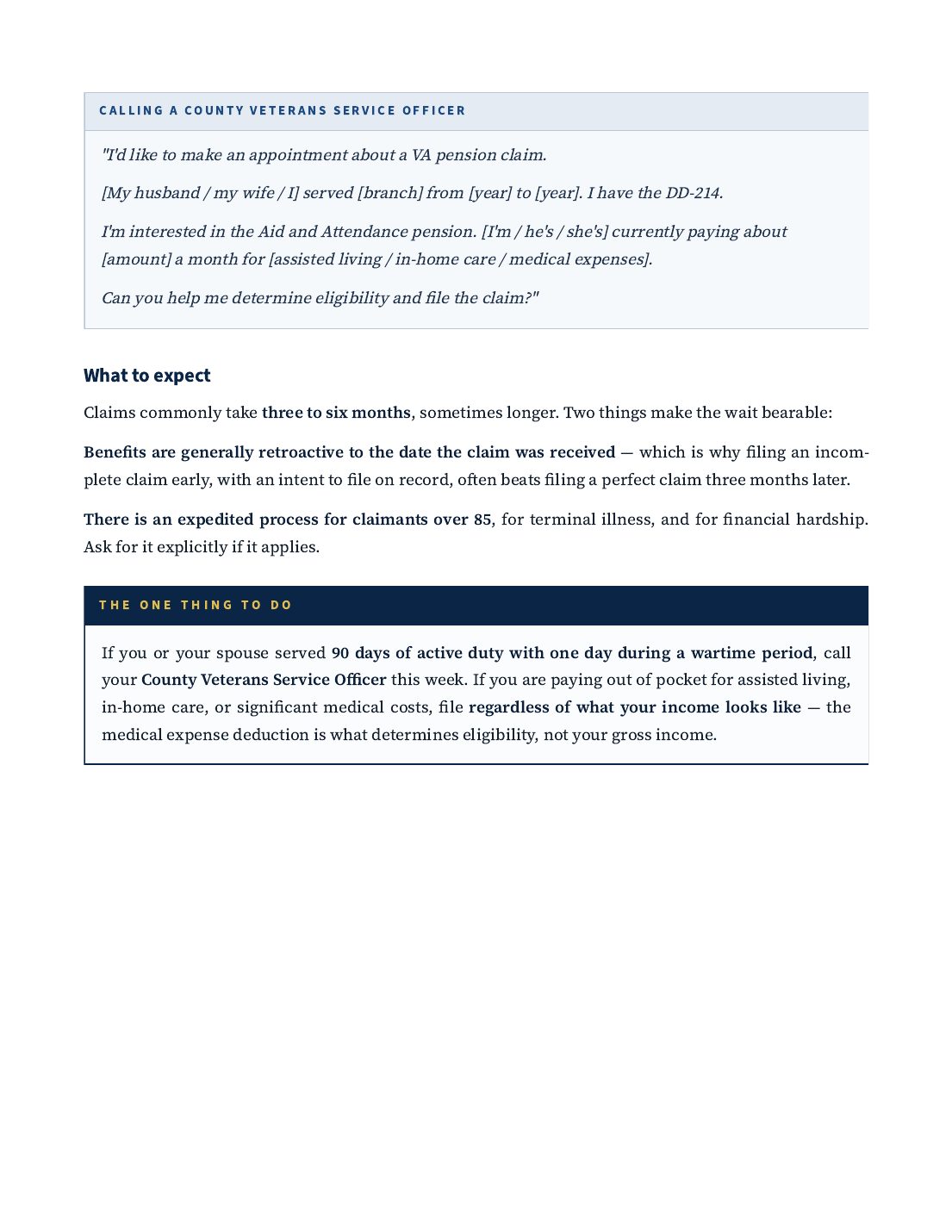
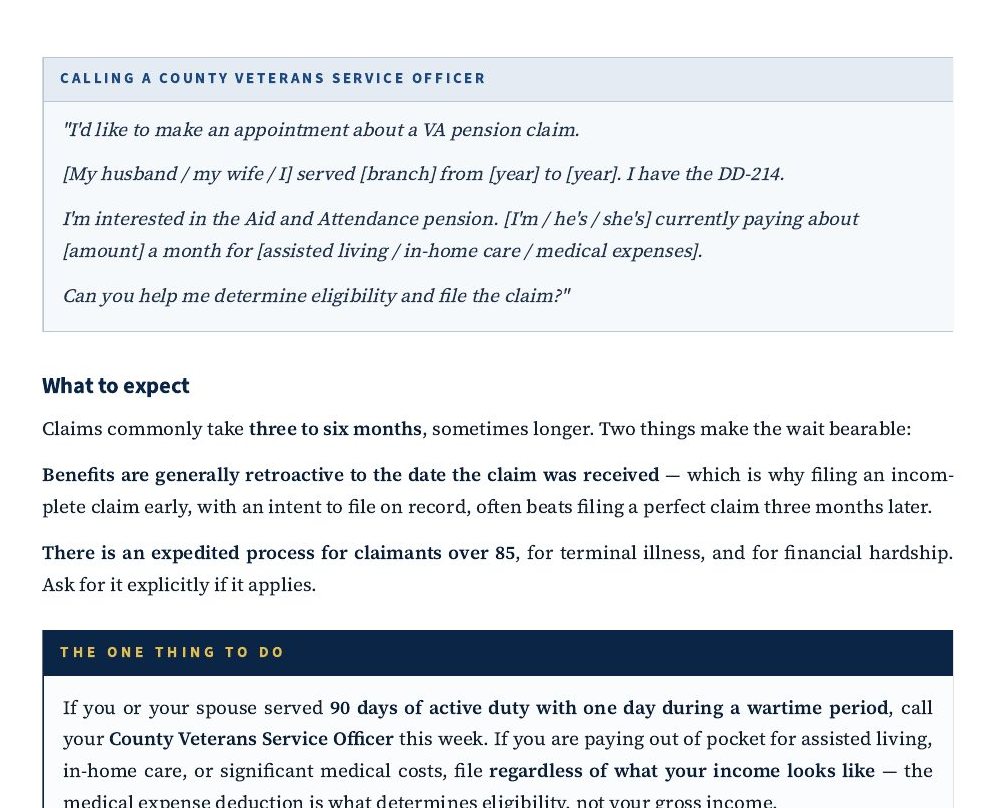
- “I paid someone to file it.”You should never pay to file a VA claim. County Veterans Service Officers do it free. The book tells you how to find yours and what to say on the first call.
The handbook won't fight a denial for you. It shows you what to file, who will help for free, and what to say — so the first application is the right one.
“I make too much to qualify” is the most expensive sentence in American retirement.
It is also, most of the time, wrong. The VA subtracts medical costs before it tests your income. Medicare's savings programs leave your house and one car out of the asset test. New Jersey's Stay NJ program for homeowners 65 and over has an income ceiling of $500,000.
Most eligible people never apply because they never look at the actual number. This book prints the actual numbers.
The National Council on Aging estimates that more than 9 million older Americans miss out on about $58 billion a year in benefits they qualify for (NCOA, May 2026).
Twenty chapters. One thing to do at the end of each.
The earnings record nobody checks · The eighteen months that decide everything · Benefits on someone else's record · The widow's penalty and the switching strategy
Five exemptions your county won't mention · The assessment is a guess · How to appeal, and how to win · The deed nobody checked
The surcharge triggered by one good year · The enrollment windows that penalize you for life · The programs that erase your premium
The $29,093 line · Three agencies, one death certificate
The name on the account · The power of attorney that isn't limited · What your will doesn't control
The deductions nobody claims · Deadlines that expire quietly · What's available if you rent · How to tell a real agency from a fake one
What this handbook won't do.
- It won't pretend your state works like every other state. Property tax rules are local. Appendix E tells you which office to call for yours.
- It won't promise you a dollar amount. It shows you the limits, the forms and the people to ask. What you receive depends on your own record.
- It isn't legal or tax advice, and it isn't from the government. It's an independent reference guide. Where the stakes are high, it tells you which professionals will help for free.
- It won't stay current forever. Most figures change every December, so every one is printed with its effective date and the agency to check next year.
1 million+ views across the Henry USA channel
People watch for plain-English benefit rules. Here's what they write underneath.
Real comments left on our YouTube videos, quoted as written. Long ones are shortened where you see “…”. There are no reader reviews here yet — this edition is new, and I'd rather show you nothing than something made up.
 Illustration
Sit down together with one chapter.
Print it — every page is letter size — or open the chapter that matches their situation on a tablet. Start with the Drawer File in Appendix F: one afternoon, one folder, and the next time something happens, nobody is searching through a shoebox.
A video can tell you a benefit exists. It can't hand you the form.
I'm Henry. I started the Henry USA channel to explain benefit rules in plain English, and the questions in the comments are never abstract. My husband served in Korea — does that mean anything for me now? My property tax went up again and I'm on a fixed income. I got a letter saying my Medicare premium is going up — is that a mistake?
A twenty-minute video can't give you the form number, the phone script, the deadline and the list of documents to bring. This handbook is the written answer. I pulled every federal figure from the agency that publishes it — ssa.gov, va.gov, cms.gov, irs.gov — and printed the date next to it.
I'm not your attorney, accountant or financial planner, and the book says so on page one. Where a decision moves real money, it tells you to check your own paperwork — and who will help you for free.
— Henry
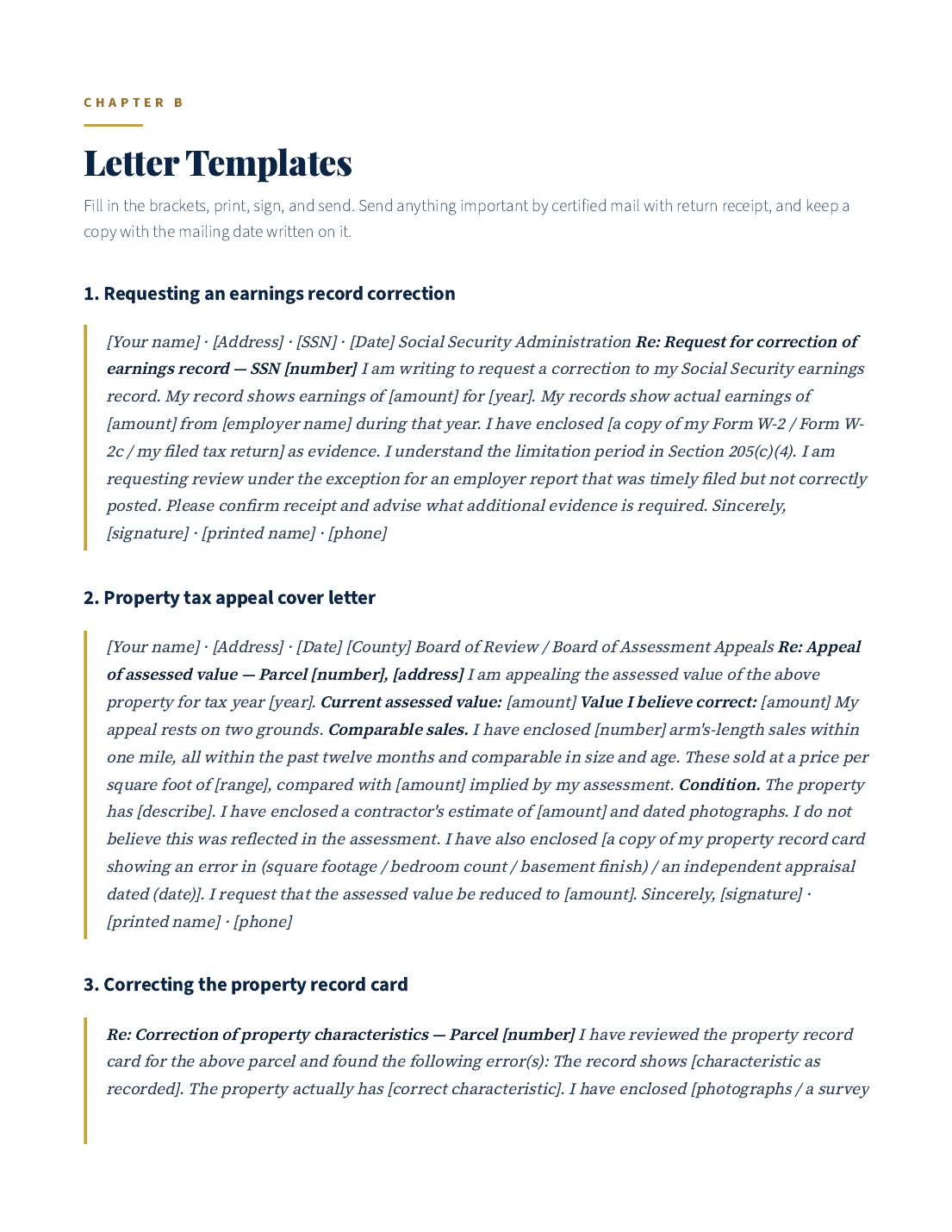
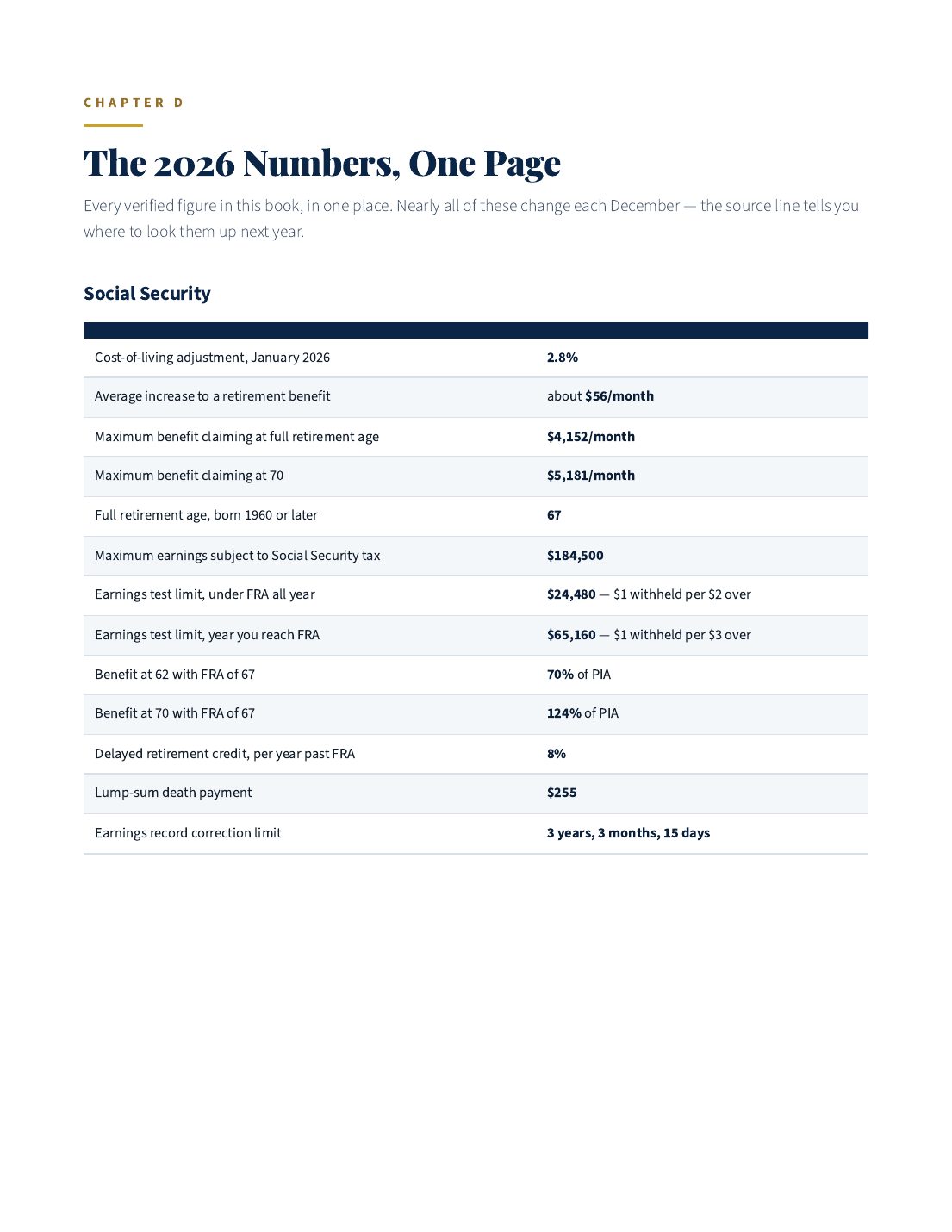
The complete 2026 edition.
$29.99
One payment · No subscription · Secure checkout by Hotmart
How it works.
- Pay once. You'll land on pay.hotmart.com — Hotmart is the payment company. I never see your card.
- Check your email. Your download link arrives within minutes.
- Open the chapter that's about you. On a phone, a tablet, a computer — or print it.
- Do the one thing at the end of it. Usually a single phone call.
Questions people ask first.
Isn't all of this free on government websites?
Yes, and that's the point. Every rule in this book is published, most of it in a .gov PDF that nobody reads. It isn't findable, it isn't readable, and no agency's job is to call you about it. What you're paying for is that it has been found, read, dated, sourced and turned into steps.
Is this a government publication?
No. It's an independent guide, not affiliated with or endorsed by Social Security, CMS/Medicare, the VA, the IRS or any government agency. A real agency will never ask you to pay to receive a benefit — Chapter 20 is about exactly how to tell the difference.
I think I make too much to qualify.
That belief is the reason most of this money goes unclaimed, and it's usually wrong. The VA subtracts medical costs before testing your income. Medicare's savings programs exclude your house and a car. The book prints the actual limits so you can check instead of assume.
Will the numbers already be out of date?
Most of them change every December, which is why every figure is printed with its effective date and the agency that published it — so you always know what you're looking at and where to check next year. This is the 2026 edition.
I'm not good with computers or forms.
Almost everything here is a phone call or a paper form. The scripts are written to be read aloud. For VA claims and tax returns, the book points you to people who will do the paperwork with you, free.
There are no reviews. Why should I trust it?
Because it's a new edition and I'd rather show you nothing than something I made up. You can check any figure against the .gov address printed beside it, and you have 7 days to ask for your money back.
How do I know this isn't a scam? Scams aimed at seniors look like this.
That's a fair question, and I'd rather you ask it. Nobody here will call you, ask for your Social Security number or ask for gift cards. You pay once, on pay.hotmart.com — Hotmart is the payment company that handles the sale and refunds, and I never see your card.
Can I buy it for my mother or father?
Yes. Use their email or yours, then forward the PDF or print it for them.
The cost of checking is an afternoon and a phone call.
The cost of not checking can run for the rest of a retirement.
Get the Handbook — $29.99 →7-day money back · Independent guide, not a government agency